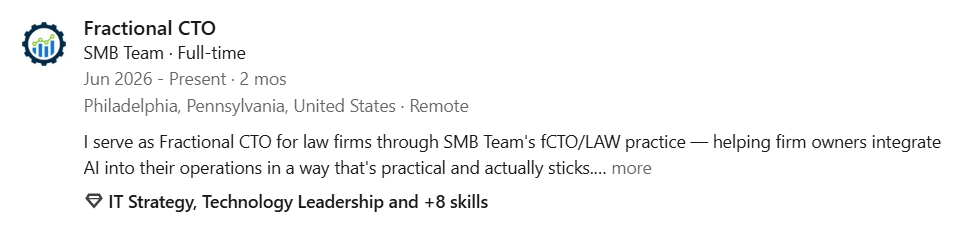
Fractional CTO Services for Law Firms
TL;DR
I serve as a Fractional CTO for law firms — providing senior technology leadership on a part-time basis. That means evaluating a firm's existing systems, shaping a practical technology and automation strategy, and implementing the tools that streamline day-to-day operations. Firms get the judgment and direction of a technology executive without the cost of a full-time hire.
What does a Fractional CTO do for a law firm?
Most firms don't need a full-time technology executive — but they do need someone who can make confident technology decisions on their behalf. A Fractional CTO fills that gap: providing the strategic oversight to choose the right tools, modernize operations, and adopt new technology responsibly, all scaled to the size and budget of the firm.
For law firms specifically, that means respecting how the practice actually runs — the confidentiality, the client relationships, and the day-to-day realities of legal work — while removing the operational drag that slows a firm down.
Technology Leadership on Demand
The core of the role is senior, vendor-neutral guidance:
- Assessing the current state — understanding the firm's existing systems, data, and workflows before recommending anything.
- Setting a practical roadmap — a prioritized plan for modernization that matches the firm's goals and budget.
- Guiding tool selection — cutting through the noise to choose technology that actually fits, and avoiding expensive mistakes.
- Overseeing implementation — making sure new tools are adopted well, not just purchased.
This is Fractional CTO leadership applied to a professional-services firm, with the same rigor I bring to any system architecture engagement.
Automating the Boring Stuff
A huge amount of a firm's time disappears into repetitive, low-value work. A big part of the role is identifying that work and automating it — freeing up the team to focus on clients and cases. Common targets include:
| Repetitive Task | What Gets Automated |
|---|---|
| Client intake & follow-up | Capturing, qualifying, and routing new inquiries |
| Document generation & routing | Producing and moving routine paperwork |
| Billing & payment follow-up | Chasing outstanding invoices |
| Scheduling & reminders | Coordinating calendars and client touchpoints |
| Data entry & CRM updates | Keeping client records accurate across systems |
| Status reporting | Turning activity into clear, regular updates |
Depending on the firm, this connects through AI Lead Capture, CRM Integration, and even a Voice AI Receptionist — so the firm meets clients wherever they reach out, without adding to anyone's workload.
Secure and Practical by Design
Any technology introduced into a law firm has to respect the firm's obligations first. Confidentiality, data security, and professional responsibility aren't an afterthought — they shape every recommendation. Just as importantly, technology is there to support the practice, not replace professional judgment: it handles the operational and administrative load so attorneys can focus on the work only they can do.
Keeping Pace with Legal Technology
The legal technology landscape moves quickly, and it's easy for a busy firm to fall behind or chase the wrong trend. Staying current — and translating what's genuinely useful into practical recommendations — is part of the ongoing value of a Fractional CTO. Firms get direction grounded in what works today, not last year's hype.
An Ongoing Partnership
This isn't a one-and-done project. The relationship continues with regular check-ins, oversight of the systems in place, support as the firm adopts new tools, and an on-call advisor for the technology questions that inevitably come up as the firm grows.
Modernizing the Practice, Not the Chaos
This is a blueprint for how a Fractional CTO brings modern technology into a law firm responsibly: assess first, automate the repetitive work, keep everything secure, and leave professional judgment where it belongs. The result is more capacity, healthier margins, and lawyers spending their time on law — not admin.
Interested in These Services for Your Firm?
If you're a law firm interested in these services, please visit SMBTeam.com for more information, or email me directly at sheamus.byrne@smbteam.com.