5/26/2026
Why do pre-built AI automation templates fail to scale enterprise revenue?
Generic, pre-built AI automation packages fail to drive profitability because true operational efficiency requires custom workflow engineering mapped directly to your internal business logic. By documenting your exact standard operating procedures and orchestrating your existing technical stack, high-growth SMBs can eliminate data silos and permanently decouple revenue from headcount.
👇Full video break down of article👇
The Reality of AI Business Automation: Why Pre-Built Templates Won't Save Your Business
If you are a business owner or operational leader, your inbox and social feeds are likely flooded with pitches from "AI Automation Agencies" promising to revolutionize your company overnight. They show flashy demonstrations of tools like n8n, Make.com, and Zapier, claiming they can install hundreds of pre-built automation templates to instantly optimize your operations. They make it sound incredibly simple. They make it sound like a turnkey miracle product.
But if you look past the slick screen recordings, the reality of business automation looks very different from the hype. Downloading generic, cookie-cutter automation packages won't streamline your business—it will likely break your existing workflows. Pre-built templates fail because true operational efficiency requires custom workflow engineering, not generic software blueprints. While agency gurus pitch massive bundles of standard automations, 99.9% of them are superficial "nice-to-haves" rather than bottom-line, operational necessities.
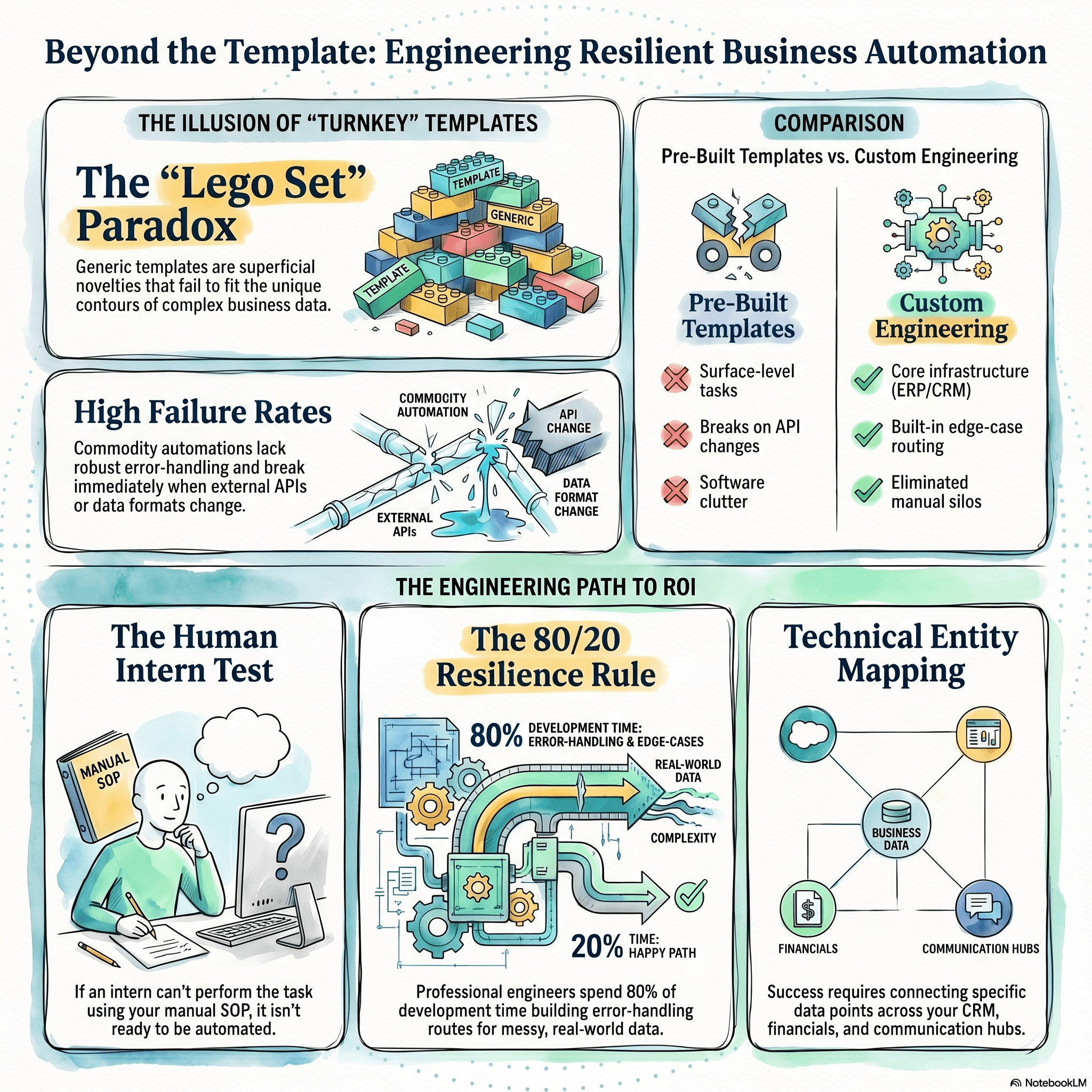
The "Lego Set" Paradox of Business Software The current AI automation trend sells the idea of productivity rather than actual corporate value. Agencies often showcase workflows that "automatically categorize your daily emails" or "send a Slack alert whenever someone tweets at your brand." To an established business, these aren't critical infrastructure—they are minor novelties.
Buying these generic packages is like buying a standard off-the-shelf Lego set and trying to use it as a custom machinery part for your manufacturing line. It doesn't fit the unique contours of your company. True, high-value business automation isn't about saving five minutes a week for a single employee; it is about connecting your deeply specific internal systems so your data flows flawlessly without human error.
The ROI of Custom Operations Engineering in CFO Language
| Feature | Pre-Built Automation Templates | Custom Operations Engineering |
|---|---|---|
| Operational Impact | Surface-level tasks (e.g., auto-tweeting, basic email alerts) | Core business infrastructure (e.g., ERP syncing, inventory tracking, CRM pipelines) |
| System Reliability | High failure rate; breaks completely when external APIs change | Robust error-handling, edge-case routing, and data logging built-in |
| Data Security | Minimal regard for corporate privacy or compliance (GDPR/HIPAA) | Secure API authentication, data encryption, and strict access controls |
| Return on Investment | Minimal. Adds software subscription clutter without moving the needle | Substantial. Eliminates manual data silos and reduces overhead hours |
What is the golden rule of business process automation?
The golden rule of automation is that you cannot automate chaos; efficient automated systems require comprehensive, manual documentation. A business process must be clear enough for a human intern to execute flawlessly with minimal guidance before it can be successfully translated into software code or AI workflows. True operational efficiency does not come from installing a random piece of automated software. It comes from a deep, granular understanding of your specific business and your existing internal processes.
The Automation Reality Check: If you can't describe a business process to a brand new employee to have them do the task with very minimal help, then it isn't ready to be automated yet—especially by an outside technology consultant.
The costliest mistake an organization can make is throwing AI or automation at a broken department, hoping the technology will magically fix the underlying confusion. It won't. If you automate an inefficient, poorly documented process, you just end up executing bad operational habits at scale. You create massive data corruption and technical issues much faster than a human ever could.
How to properly audit your company's workflows before touching AI
If you want to move past the market hype and invest in automation that actually drives enterprise profitability, you must follow a disciplined, documentation-first approach before hiring an expert or writing code.
1. The Human Intern Test (SOP Mapping) Before looking at automation platforms, map out your Standard Operating Procedure (SOP) for a specific task. Write it down step-by-step. If a new internal employee cannot read that document and successfully complete the task without asking five clarifying questions, your workflow is too ambiguous. Software frameworks and webhooks require absolute, rigid logic; they cannot guess your management intent.
2. Identify Your True Technical Entities Look at the actual core software tools your business relies on daily. True automation requires connecting these specific data points together securely. Map out exactly where your data lives:
- CRM & Sales: Platforms like Salesforce, HubSpot, or Pipedrive.
- Databases & Financials: PostgreSQL, Quickbooks, or internal SQL servers.
- Communication Hubs: Slack, Microsoft Teams, or dedicated email relays.
3. Account for "Edge Cases" (The Real World) A pre-built template assumes a perfect world where every incoming email is formatted exactly the same and every customer fills out an order form correctly. Real business is messy. A professional automation engineer spends 20% of their time building the main workflow pathway, and 80% of their time building error-handling routes to catch, log, and alert your team when a piece of data is missing or corrupted.
Key Strategic Takeaways
- Claim: Custom workflow architecture securely connects your existing technical entities to instantly eliminate manual data silos and bridge deeply specific internal systems.
- Constraint: This strategy is NOT for organizations looking to buy "turnkey" miracles to fix underlying management confusion without doing the hard work of documenting their processes first.
- Outcome: Drastically reduces overhead hours and data corruption, actively transforming your manual standard operating procedures into highly profitable digital assets.
Conclusion: Scale Revenue, Not Chaos
Is business automation a scam? No—but the cookie-cutter automation agency hype machine certainly is. There is immense, transformative financial value in automating your corporate workflows, but the solutions that yield a true return on investment aren't downloaded from a generic online store. They are forged when an expert sits down with your leadership team, audits your messy operational workflows, helps you write thorough technical documentation, and engineers a resilient solution tailored exclusively to the unique DNA of your business.
Stop buying into the cookie-cutter illusion. If you are ready to overlay an intelligent, custom automation layer onto your existing tech stack, let's talk about implementing a Fractional CTO strategy that protects your P&L.
👇Full video break down👇