4/8/2026
Why Do Most AI Initiatives Fail to Deliver Real ROI?
Incomplete discovery is the silent killer of AI project budgets and P&L. Understanding unique operational contexts before deploying technology is critical to prevent costly overruns and ensure tangible business outcomes.
The biggest trap in AI implementation isn't the technology itself; it's the fundamental misunderstanding of what problem you're actually trying to solve. Many leaders rush to solutions, acquiring "AI capabilities" without genuinely interrogating their operational ecosystem. This approach leads to expensive reworks and missed strategic targets, turning a potential competitive advantage into a significant cost center.
Think about it like this: a client asks for a "small change" late in a project, like adding multi-tenancy to a nearly complete database. What seems trivial to them is a colossal structural overhaul for the architect. This isn't malicious; it's a gap in early, deep discovery. They didn't know what questions to ask, and often, neither did the builder.
Why do AI initiatives frequently derail post-implementation?
The primary culprit is a shallow understanding of an organization's true operational needs and future scale. Many AI consultants promise a "solution" for a price, then try to apply a cookie-cutter template. They skip the uncomfortable questions about your unique workflows, legacy systems, and long-term strategic vision. This shortcut inevitably leads to friction, integration nightmares, and a solution that fails to truly eliminate operational drag.
Such an approach means the AI, even if technically sound, becomes another siloed tool, not an orchestrator. It adds complexity instead of reducing it, potentially increasing manual intervention rather than minimizing it. Your P&L reflects this in wasted budget, delayed ROI, and an inability to decouple revenue growth from escalating headcount costs.
What's the real cost of a "cookie-cutter" AI solution?
A one-size-fits-all AI strategy rarely fits anyone well. These generic solutions often ignore critical business nuances, regulatory constraints, or the specific data architecture required for your industry. The "fixed price" for a pre-packaged solution quickly balloons into change orders and additional consulting hours when it inevitably clashes with your existing tech stack or unique operational processes.
The hidden costs extend beyond the initial budget. There’s the opportunity cost of resources diverted to fixing a poorly implemented system, the ongoing operational drag, and the demoralizing effect on teams. This leads to a failure to achieve the promised efficiencies, decoupling output from revenue, or unlocking new revenue streams—the very reasons AI was pursued.
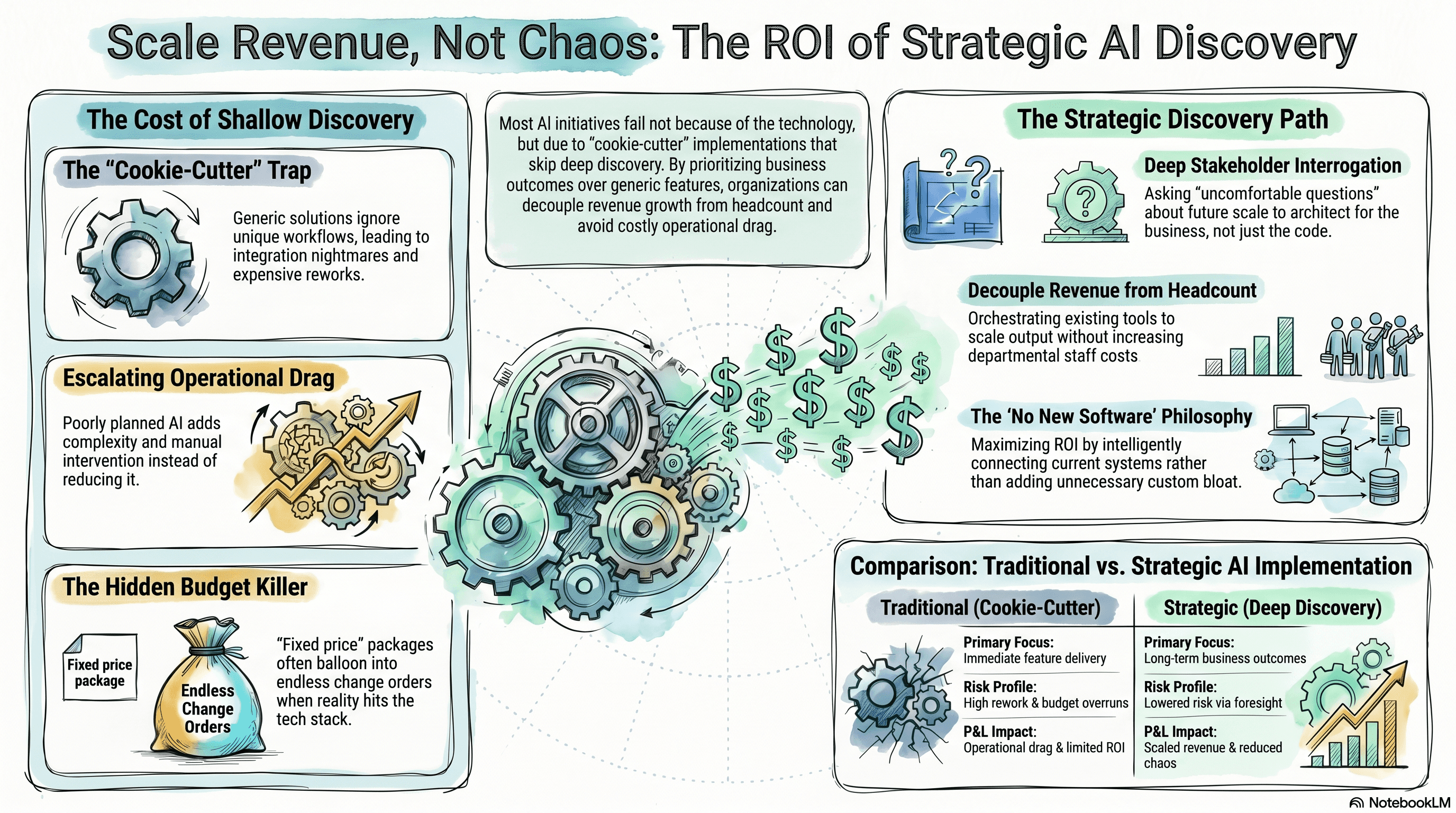
| Traditional Approach (Cookie-Cutter) | Strategic Alternative (Deep Discovery) |
|---|---|
| Focus: Immediate feature delivery, fixed scope. | Focus: Business outcomes, future scalability. |
| Discovery: Superficial, assumed generic needs. | Discovery: In-depth, stakeholder-driven questioning. |
| Risk Profile: High rework, budget overruns. | Risk Profile: Lowered, mitigated by foresight. |
| Solution: Often adds new, siloed software. | Solution: Orchestrates existing tools, 'No New Software'. |
| Outcome: Operational drag, limited ROI. | Outcome: Scaled revenue, reduced chaos, tangible ROI. |
How does deep discovery safeguard budget and P&L?
Rigorous discovery acts as an upfront investment that prevents catastrophic financial losses down the line. It involves asking the "uncomfortable questions"—where is this going in 12 months? Who else uses this besides you? What happens when you scale to B2B? This phase isn't about coding; it's about deeply understanding the business, process, and data architecture.
By committing to a thorough discovery phase, you architect for the future, not just the present. This ensures that any AI solution effectively integrates with your existing tools, eliminates manual processes, and directly contributes to your P&L by reducing operational expenditures and unlocking new revenue potential. It's how you scale revenue, not chaos, without building new, unnecessary software.
Who benefits most from this strategic approach?
This deep, diagnostic approach is not for every organization. It's explicitly NOT for those seeking a magical "AI button" to solve problems they haven't clearly defined. It's not for leaders who prioritize cheap, cookie-cutter solutions over strategic, sustainable transformation, or who are unwilling to invest the time in truly understanding their foundational operational reality. If you're looking for a quick, generic fix that ignores your unique business context, this path will only lead to further frustration and wasted capital.
This strategy is for C-Suite executives and Directors who are serious about achieving measurable ROI from AI investments. It's for leaders determined to decouple output and revenue from headcount, optimize departmental budgets, and eliminate operational drag by orchestrating their existing tools intelligently. If you seek to scale revenue, not chaos, through meticulously planned, outcome-driven AI implementation, then a focus on deep discovery is non-negotiable.
Ready to understand the true potential of AI for your P&L, not just another piece of software? A Fractional CTO provides the strategic foresight to navigate this complexity, ensuring your AI investments deliver tangible value without building custom bloat.